The buildings dating to the Middle Ages in Toulouse !!! .
- Franck BRUGUIERE
- Jan 9
- 4 min read


INTRODUCTION :
In the region of Toulouse, when people talk about towns dating back the Middle Ages, they immediately think of magnificent city of " Carcassonne " .
But Toulouse was also a fortified medieval city, and you can still a few restored remains of it !!!.
( Boulevard Alfred Duportal and near our contemporary museum " Les Abattoirs " ) .
Indeed, the fortifications were built in several phases between the 12th. and 16th. centuries.
Ultimately, Toulouse was surrounded by fortifications with towers, gates, and moats, all of which were reinforced during the Wars of Religion .
I propose you to discover the buildings dating back to the Middle Ages that still remain scattered throughout Toulouse.
HISTORY : The different style of buildings dating to Middle Ages in Toulouse :
Toulouse has not always been the Pink City !!! .

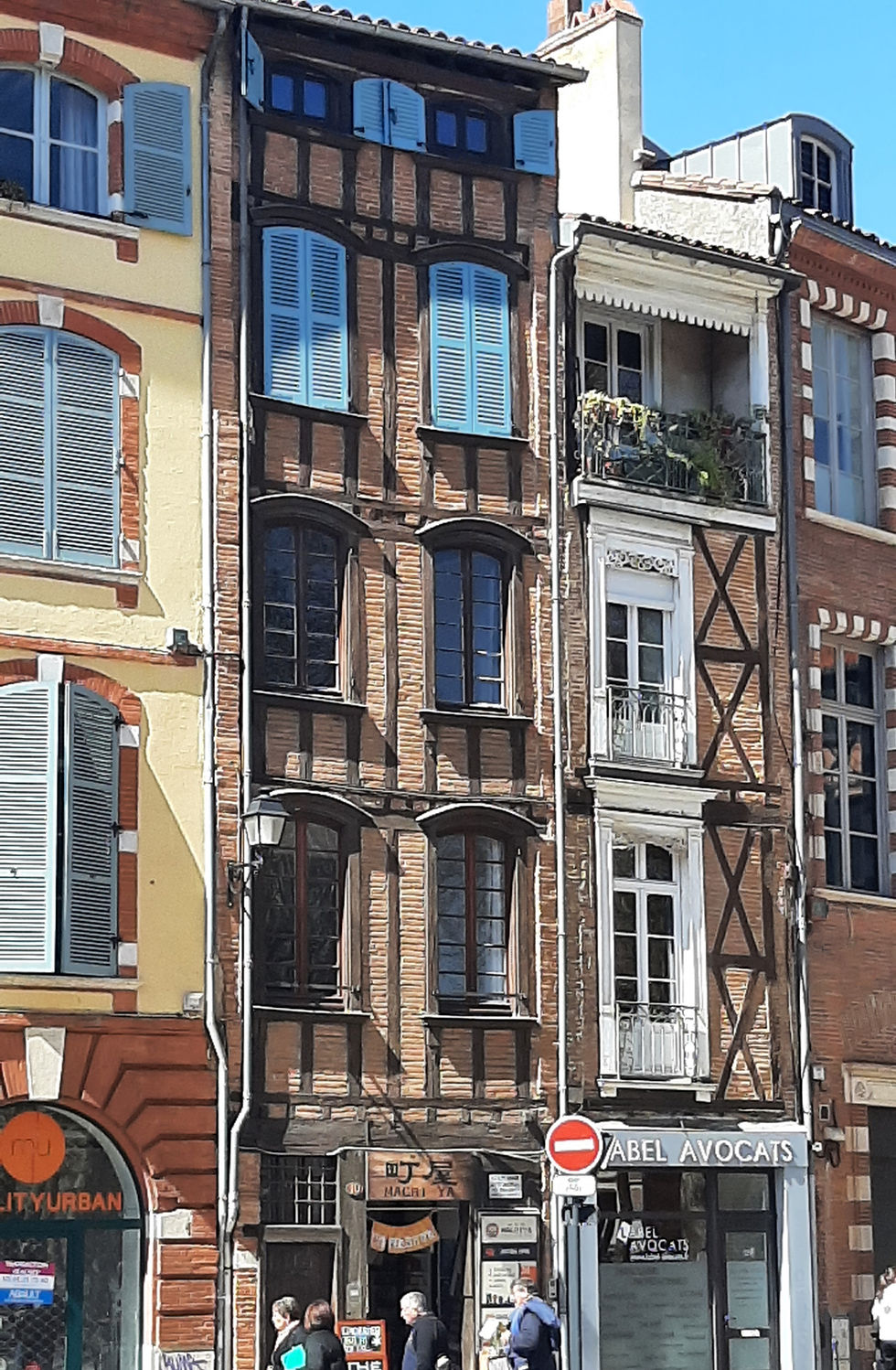
In the Middle Ages, only the buildings of bourgeois and religious famileis were made of brick .
-The houses for poor or modest families :

Most of dwellings belonging to modest families were built of wood and wattle and daub-clay, earth, straw, sand, and water .
The carpenter installed the timber framing " colombage " , an exposed wooden structure on the façades.
It could be horizontal, vertical or diagonal.
Then, the spaces between the large wooden beams were filled with different materials, wattle, daub, bricks for the wealthier constructions, plaster and stone .
-The houses of wealthier families :


In this type of house, the spaces between the wooden structures were filled with bricks.
But these were reserved only the wealthiest members of the city.
These buildings had façades called " corondage " , meaning they were filled with bricks .
Conclusion :
All these different types of constructions were mixed together in the narrow streets throughout the city of Toulouse !!! .
The Problem of Fires :

The majority of Toulouse at the time, like all cities in Europe, consisted of modest wooden dwellings.
Numerous fires often broke out and destroyed homes.
In Toulouse, the fire of May 7, 1463, destroyed two-thirds of the old city.
It is said that the fire started from a baker's oven !!! .
Fueled by the local wind known as th " Autan " of Toulouse, it lasted 1é days and destroyed more than 7000 homes .
The Reconstruction of Toulouse :
It was King " Louis XI " who personally traveled to Toulouse in order to see the extensive damages .
He made a decision for the reconstruction of Toulouse :
The Pink City would no longer pay the royal tax or another tax called " taillle " for 100 years .

Toulouse became a major construction site, as the city needed to be built .
In just 25 years, it can be said that it was beautiful !.
Indeed, the materials used were noble, namely white stone or brick .
It was ih the 16th. century that the marchants who had made their fortune with the handel of the " Pastel " ( The blue pigments that conquered the world and brought about Toulouse's golden age ) built the many mansions that the city is known for .
The poorest populations, on the other hand, lived in the suburbs of Toulouse.
The " Capitouls " , who were the administrators of Toulouse at the time, took measures against fires :

The big fires have stuck Toulouse during the centuries stayed in the mind of the all inhabitants of the Pink City .
The " Capitouls " decided to take measures to protect Toulouse from fires :
Lookouts were stationed atop the city's bell towers to sound the alarm in case of fire .
The Wooden eaves on rooftops were banned .
As early as 1550, shared brick walls between buildings were imposed .
A few years later, timber framing and wooden structures were banned .
Indeed, in 1733, chimney sweeping was made mandatory.
Discovering Medieval Toulouse Dwellings Today :

As I always tell you, the charm of Toulouse is that you will have to go and discover it for yourself.
Indeed, buildings dating back to the Middle Ages are present throughout the city center of Toulouse.
However, you will find some very fine examples ( Rue des Filatiers ) .
This street connects the Carmes covered market to Esquirol Square .
That's all for today, my friends.
I hope this journey back to the Middle Ages has fascinated you.
Don't hesitate to explore the Pink City by visiting its splendid buidings !!! .
Welcome in Toulouse.
The blog from Toulouse.
Best regards, Franck.
BONUS PHOTOS : THE BUILDINGS DATING FROM THE MIDDLE AGES IN THE CITY CENTER OF TOULOUSE :


BONUS PHOTO : THE BUILDING DATIND FROM THE MIDDLE AGES LOCATED ( 5 , rue des Filatiers 31 000 TOULOUSE ) :



BONUS PHOTO : A LOVELY BUILDING FROM THE MIDDLE AGES IN TOULOUSE NEAR THE MONOPRIX ( rue, Alsace-lorraine ) :

-
`EXTRA VIDEOS :


Comments